FUNDAMENTALS OF LEAF SPRING SUSPENSION SYSTEMS
Leaf springs are the backbone of commercial vehicle suspension systems worldwide. Despite being one of the oldest suspension technologies, modern leaf springs have evolved significantly and remain the most efficient, durable, and cost-effective solution for trucks, vans, pickups, and trailers.
This comprehensive guide covers everything you need to know about how leaf spring suspension systems work, from their core functions to their mounting mechanisms and why they continue to dominate the commercial vehicle sector.
What are the functions of a leaf spring?
Although commonly referred to simply as a "spring," a leaf spring serves several critical functions in the suspension system of a vehicle — far beyond just absorbing shocks.
1. Structural link between axle and chassis
The primary mechanical role of a leaf spring is to connect the axle to the vehicle's chassis. This means that the spring not only supports vertical loads, but also ensures the correct positioning of the axle under all driving conditions.
If the leaf spring — especially the main (top) spring leaf — is broken, loose, or missing, the axle is no longer properly secured. In extreme cases, this can lead to:
-
Axle misalignment
-
Unstable handling
-
Loss of control of the vehicle
2. Controlling axle direction and alignment
A leaf spring also plays a guiding role. It keeps the axle aligned and prevents unwanted forward, backward, or lateral movement.
If the leaf spring has incorrect dimensions or the left and right sides differ in height, length or stiffness, the axle will not remain parallel to the chassis. This leads to issues such as:
-
Irregular tire wear
-
The vehicle pulling to one side
-
Poor handling or steering response
3. Load support and ride control
Leaf springs are part of a larger suspension system, which typically includes:
-
Leaf spring
-
Shock absorber
-
Bump stop
-
Tires (the final contact with the road)
-
Stabilizer bar (optional, depending on model and axle type)
Together, these components ensure that the suspension can:
-
Maximize tire-to-road contact
-
Maintain vehicle stability and cornering safety
-
Distribute weight evenly across all wheels
-
Deliver both ride comfort and cargo protection by absorbing bumps and vibrations
How is a leaf spring mounted to the axle and chassis?
A leaf spring must be securely mounted to both the axle and the chassis to perform its full function. The reliability and safety of a suspension system heavily depend on the proper connection of these components.
Axle connection: U-bolts and center bolt
The leaf spring is attached to the axle using U-bolts, which tightly clamp the spring to the axle beam. Between the axle and the leaf spring pack, there's usually a spring seat or saddle, sometimes combined with a rubber isolator or locating pin.
Key parts involved:
-
U-bolts: These wrap around the axle and fasten the spring pack using heavy-duty nuts
-
Top plate: Sits on top of the spring pack and holds the U-bolts in place
-
Center bolt (spring bolt): Passes through the entire leaf spring pack vertically and locates the axle precisely in the center, preventing lateral movement
Important: If U-bolts are not torqued correctly or become loose, the axle may shift or rotate, leading to unsafe driving conditions.
Chassis connection: eyes, bushings, shackles
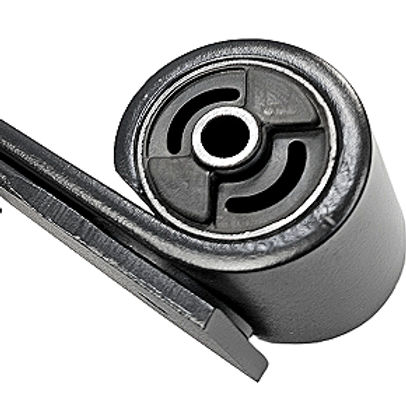
At both ends of the leaf spring, there are spring eyes formed in the ends of the main leaf. These are the connection points to the vehicle chassis.
There are two types of mounting:
-
Fixed eye (usually front): Bolted directly to the chassis or to a mounting bracket using a bolt and rubber or polyurethane bushing
-
Shackle (usually rear): A hinged link that allows movement as the spring flexes
The purpose of the shackle is to:
-
Allow the spring to change length (flatten and arc) as it deflects
-
Prevent binding and excessive stress at the spring eye
-
Provide smooth articulation of the suspension
Bushing function
The bushings inside the spring eyes (usually rubber, combination of rubber and metal, copper or polyurethane) absorb vibration, isolate road noise, and allow controlled movement of the spring.
Over time, worn bushings can cause:
-
Clunking noises
-
Uneven tire wear
-
Misalignment or imprecise axle control
-
Vibration
-
Breakage of leaf spring at the spring eye
Are leaf springs old-fashioned solutions?
Although leaf spring suspension systems have been used for more than 150 years, they are far from outdated. In fact, modern leaf spring technology has evolved significantly — especially over the last four decades with the introduction of the parabolic leaf spring.
Today, leaf springs remain one of the most efficient and cost-effective suspension solutions, particularly for commercial vehicles. Their simplicity, durability, and load-carrying capability make them a preferred choice in many vehicle categories.
Ongoing developments
Modern leaf springs have been enhanced through:
-
High-stress spring steels that increase fatigue resistance
-
Composite materials that reduce weight without compromising load capacity
-
Advanced geometry (such as parabolic tapering) that improves ride comfort and axle control
Current market usage
Heavy-duty trucks and trailers:
-
Around 60-70% use leaf springs on one or more axles
-
Among them: 70-80% use parabolic leaf springs
-
20-30% use multi-leaf (conventional) springs — mainly construction trucks
Light commercial vehicles (3.5 to 7 tons):
-
Approximately 90% use leaf springs on the rear axle
-
Around 10-20% also use them on the front axle
Pickup trucks:
-
About 90% of leading pickup brands worldwide rely on multi-leaf springs on the rear axle
-
Chosen for high payload capacity, off-road durability, and low maintenance needs
Conclusion: Leaf springs are not relics of the past — they are highly optimized, modern components that continue to serve essential roles in global transportation.
Why leaf springs are the most efficient solution for commercial vehicles
When designing or selecting suspension systems for commercial vehicles, efficiency, durability, and cost-effectiveness are critical factors. While coil springs are commonly used in passenger cars, leaf springs remain the most practical and efficient solution for vans, pickup trucks, trucks, trailers, and other commercial vehicles.
Cost-efficiency is crucial
In the commercial vehicle segment, operating and manufacturing costs have a direct impact on competitiveness. Fleet operators and manufacturers look for solutions that offer:
-
High payload capacity
-
Long lifecycle
-
Minimal/easy maintenance
-
Competitive production costs
Leaf springs meet all of these requirements more effectively than coil spring-based systems.
Best cost-performance ratio
Leaf springs provide high load-bearing capacity at a relatively low material and manufacturing cost. Unlike coil springs, which often require separate components for guiding, positioning, and stabilizing the axle, leaf springs are self-supporting and multifunctional:
-
They carry vertical loads
-
Maintain axle positioning and alignment
-
Offer lateral and longitudinal stability
-
Often eliminate the need for trailing arms or track bars
Low system complexity
A leaf spring suspension system is mechanically simpler than coil spring-based systems. With leaf springs, fewer moving parts mean:
-
Easier installation
-
Lower maintenance
-
Improved durability
-
Lower risk of mechanical failure
Progressive spring behavior
Leaf springs can achieve progressive spring behavior through multiple well-proven methods:
-
Helper springs that engage only under heavy loads
-
Multi-stage leaf packs that progressively stiffen with deflection
-
Parabolic leaf springs with variable spring rate
This means leaf springs can offer both comfort when unloaded and stiffness when fully loaded, eliminating the need for complex active suspension systems.
Superior load handling and axle stability
Unlike coil springs, which require complex suspension geometry to guide the axle, leaf springs inherently control axle movement in all directions. This makes them ideal for:
-
Heavy payloads
-
Tow vehicles
-
Rough terrain
-
Rear axles of commercial vans, pickups, and trucks
Key takeaways
-
Leaf springs provide structural connection, axle control, and load support
-
Modern leaf springs are highly evolved and efficient
-
They offer the best cost-performance ratio for commercial vehicles
-
Simpler, more durable, and easier to maintain than coil spring systems
-
Dominate the market in trucks, vans, pickups, and trailers worldwide
Related topics
Continue learning - explore these related topics: