LEAF SPRING PURCHASE: HOW TO BUY PROPER LEAF SPRING FOR A VEHICLE
Buying a leaf spring starts with the proper identification of the spring that fits the specific vehicle. Without accurate matching, even the highest quality spring may lead to installation issues or poor performance.
In most cases there are many variants for the same vehicle. Example: for a Mercedes Sprinter 2006 - 2018 there are more than 40 leaf spring variants.
There are several ways to identify the correct leaf spring, depending on the information available - such as vehicle specifications, original part numbers, or physical measurements. In addition, there are other important factors to consider before purchase.
We will explain each of these aspects in more detail in the sections below.
How can I identify leaf springs for my vehicle?
Using the leaf spring article number (OEM reference)
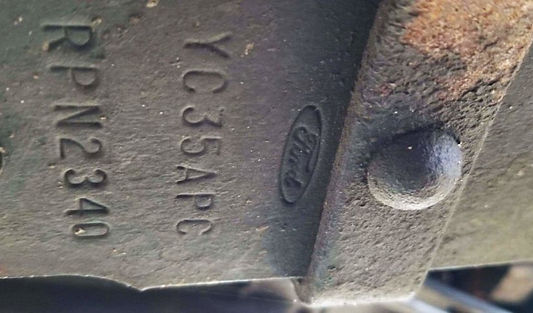
If you know the article number or OEM part number, you can search for it directly in an online catalog. The part number is often:
-
Stamped into the metal of the spring
-
Printed on a label
-
Painted directly onto the surface (white marking)
This method is the most reliable and gives 100% certainty that you are ordering the exact replacement.
Identification via vehicle data
If the OEM number is not available, you can provide your vehicle data to a spare parts dealer or suspension specialist. Based on the production year and Vehicle Identification Number (VIN number, earlier called chassis number), the appropriate spring can typically be identified with a high level of confidence.
The VIN is a unique 17-character code that acts as the fingerprint of your vehicle. It contains important information such as:
-
The manufacturer
-
The model and series
-
Production year
-
Plant of assembly
For identifying the correct leaf spring, the VIN helps determine the exact suspension configuration that was originally fitted to your vehicle at the factory. This is particularly useful when multiple spring versions were used on the same model across different years or markets.
Where to find the VIN
You can usually find the VIN in the following locations:
-
On the vehicle registration document (typically in Field E)
-
On the dashboard, visible through the windshield (driver's side, lower corner)
-
On a metal plate or sticker inside the driver's door frame
-
Inside the engine bay (on a metal plate or stamped on the chassis)
When providing the VIN to a spare parts dealer or suspension specialist, make sure to copy it exactly—including all letters and numbers—as even a small error may lead to incorrect identification.
Ordering by production year and number of spring leaves
In some cases—especially with pickups or light commercial vans—it may be possible to identify the correct spring by supplying:
-
The vehicle's production year
-
The number of spring leaves in the pack
This method is only recommended when limited spring variations exist for the vehicle.
Identification by measurements
You can also measure the main dimensions of your current leaf spring:
-
Length (eye to eye or overall)
-
Width
-
Thickness of the leaves
-
Arching (camber)
These measurements can help your parts dealer offer a matching spring. However, 100% accuracy cannot be guaranteed, as important design details (like eye type, hole position, or bushing compatibility) may vary.
Note for modified or second-hand vehicles
If you're unsure whether the suspension has been modified by a previous owner, you can send photos and available information to your parts supplier. This can help visually compare and assist with the correct recommendation.
Do I have to replace leaf springs in pairs?
When replacing leaf springs, a common question arises: Should both sides be replaced, or only the damaged one? The short answer is: not always—but in some situations, replacing both springs is strongly recommended.
In practice, around 70% of customers replace only one spring, and it rarely leads to problems. However, there are several cases where replacing leaf springs in pairs is advisable:
Significant age or wear on the remaining spring
If the vehicle is older, the spring on the opposite side may have lost its strength over time. Installing a new spring on one side and leaving a weakened spring on the other may cause the vehicle to sit unlevel, affecting ride quality and handling.
Extended use with a broken spring
Driving for a longer time with a broken spring places additional stress on the opposite spring, increasing the risk of fatigue or failure. In such cases, it's smart to replace both springs to avoid a second repair soon after.
Minimizing downtime in commercial use
Companies operating fleets or commercial vehicles often choose to replace springs in pairs during service. This helps avoid unscheduled downtime and reduces the overall risk of future failures.
Conclusion:
If the existing spring is relatively new and undamaged, replacing just one spring is typically sufficient. But for older, heavily loaded, or commercial vehicles, replacing both leaf springs may provide better long-term reliability and performance.
Can I replace just one spring leaf instead of the entire leaf spring pack?
When a leaf spring pack consists of multiple spring leaves and only one is broken, it's natural to ask: Is it possible to replace just the damaged leaf instead of the whole assembly?
Technically yes—but not always offered
It is technically possible to replace a single spring leaf rather than the entire leaf spring pack. However, this option is typically only available through specialized leaf spring workshops or manufacturers. General spare parts dealers usually only offer complete leaf spring assemblies.
When replacing a single leaf makes sense
Replacing individual leaves is most common and cost-effective in heavy-duty truck applications, where spring packs often consist of 8 to 15 leaves. In such cases:
-
The cost of a full replacement is significantly higher
-
The individual spring leaves are often stocked separately
-
Replacing a single damaged leaf can result in substantial savings
This approach can also be worthwhile in multi-leaf suspension systems where only a minor or helper spring is broken, and the remaining leaves are in good condition.
What to consider before replacing a single spring leaf
Even in suitable cases, a few things must be carefully checked:
-
If the vehicle was driven with a broken spring leaf for an extended period, the remaining leaves may have suffered extra fatigue or stress and should be inspected for cracks, deformation, or wear
-
Disassembling and reassembling a spring pack requires proper tools and safety precautions due to the high preload and tension in the system
-
A mix of old and new spring leaves may result in uneven stress distribution and affect performance or durability over time
Conclusion:
Replacing just one spring leaf is technically feasible and may offer real savings—particularly in multi-leaf packs on heavy-duty commercial vehicles. However, for light commercial vehicles or spring packs with only 2–3 leaves, full replacement is usually the more practical and reliable option.
Always consult a specialist leaf spring supplier to evaluate the best solution for your specific case.
Key takeaways
-
Accurate leaf spring identification is critical—one vehicle model can have 40+ variants
-
OEM part numbers provide 100% certainty for correct replacement
-
VIN-based identification is highly reliable when part numbers are unavailable
-
Most customers (70%) replace only one spring successfully
-
Paired replacement recommended for older vehicles or after extended use with broken spring
-
Single leaf replacement is possible but typically only for heavy-duty trucks with 8-15 leaf packs
-
Measurements can help but don't guarantee 100% accuracy due to design details
-
Production year and leaf count work for vehicles with limited spring variations
-
Photos help identify springs on modified or second-hand vehicles
-
Specialized workshops offer individual leaf replacement; general dealers sell complete assemblies
Related topics
Continue learning - explore these related topics:
-
Previous: Possible problems with leaf springs: why they need to be replaced sometimes
-
Next: Replacing a leaf spring
-
Fundamentals: What are leaf springs and how do they work?