LEAF SPRING ENHANCEMENT
Leaf spring enhancements are essential for improving vehicle stability, restoring ride height, and preventing rear-end sagging when the vehicle is loaded or modified. Whether you're transporting heavy cargo, operating a van with a custom-built body, or simply want better suspension performance, several proven upgrade solutions are available.
Why might factory leaf springs need reinforcement?
There are several reasons why the original leaf springs on a vehicle may not provide sufficient support in real-world use. Reinforcing the suspension is often the only practical solution—especially for vehicles used under demanding load conditions. Below, we outline the most common scenarios where upgrading or strengthening the factory leaf springs becomes necessary.
Heavy loads or overloading the vehicle
When a vehicle is used close to or beyond its maximum payload capacity, the rear end often sags significantly. This reduces the remaining suspension travel, and on uneven roads the rear axle may repeatedly hit the bump stops. This creates severe stress on the chassis and other components.
Beyond the structural damage, driving comfort and stability also suffer:
-
The vehicle sways and rocks from side to side
-
It leans heavily in corners
-
Bump stops frequently bottom out with loud impacts
-
Road vibrations and uneven surfaces are felt more inside the cabin
-
The front wheels may lose traction, especially under load
-
Headlights tilt upward and dazzle other drivers
-
Vehicles with a tow bar often scrape over speed bumps or ramps
-
Viewed from the side, the vehicle "sags in the rear"—something customers often describe exactly this way
-
Over time, the chassis can bend or develop cracks
-
Springs may soften over the years, causing sagging even when unloaded
All these symptoms make driving more fatiguing, especially on long journeys. Unfortunately, manufacturers rarely offer factory solutions to address these real-world problems.
Modifications and aftermarket body structures
Vehicles equipped with custom bodies - such as cranes, refrigeration units, hydraulic tail lifts, tippers, or camper van installations - require suspension adjustments. Without reinforcement, the rear of the vehicle may sit too low even when empty. Reinforced or additional springs are necessary to restore the correct ride height and maintain handling safety.
Single-leaf or composite springs in modern vans
To reduce weight and manufacturing costs, many modern light commercial vehicles come equipped with single-leaf springs or composite (plastic) leaf springs instead of traditional multi-leaf setups. While this helps fuel economy, these springs often lose their flexibility after just a few years, causing the rear suspension to sag permanently.
Why 3.5-ton vehicles are often overloaded in practice
Vehicles with a maximum gross weight of 3.5 tons are extremely popular due to the many regulatory and financial advantages they offer over larger trucks:
-
Much lower road tolls on highways
-
No tachograph required (no strict driving time limits or speed restrictions)
-
Allowed to enter city centers and restricted zones
-
Can be driven with a regular (B-category) driver's license
-
Usually exempt from parking height restrictions
As a result, these vans are often operated above their legal payload limits, and frequently exceed speed limits. Although their official payload is typically 800–1300 kg, their large cargo space allows them to carry 3–4 tons in practice.
It's not uncommon to see such vans driving at 160 km/h on highways, while heavy trucks are limited to 90 km/h. In overloaded conditions, the following issues often occur:
-
Accelerated wear on tires, rims (which may bend or crack), and even chassis structures
-
Visible rear sagging, even from a distance
-
Reduced suspension function, as the bump stops are constantly compressed
-
Longer braking distances, since the brakes were not designed for overloads
-
Risk of fines, as police may carry out roadside weight checks. Fines can reach €1000 to €3000
Important note:
While reinforcing leaf springs is often necessary and helpful, it does not solve the problem of overloading. Driving with excess weight is illegal and remains entirely the responsibility of the driver or operator. Spring upgrades improve safety and comfort within reasonable limits—but they do not raise the legal payload capacity of the vehicle.
Overview of leaf spring enhancement solutions
On the market there are four main categories of suspension enhancement products to meet the varied needs of light commercial vehicle owners:
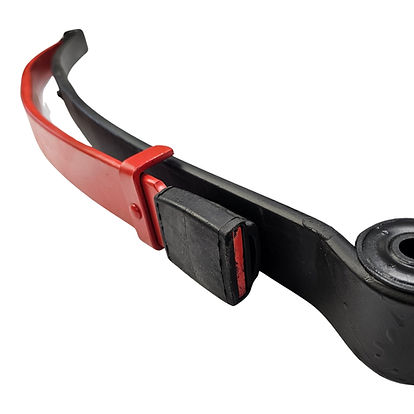
Leaf spring reinforcement sets (add-on leaves)
These reinforcement kits (or sets) are the most common solution when a vehicle needs stronger rear suspension. The kit typically includes one or more additional spring leaves that are installed below the existing leaf spring pack. They increase load capacity, reduce sagging under heavy loads, and restore proper ride height—all without significantly altering ride comfort when the vehicle is unloaded.
Key benefits:
-
Increases suspension strength
-
Reduces rear-end sag
-
Preserves factory handling and comfort
-
Simple mechanical installation
Disadvantages:
-
Linear spring rate
-
Installation is a rather big effort
Auxiliary air suspension sets
Air helper springs (also known as air suspension assist kits) are installed between the chassis and the rear axle. These heavy-duty rubber bellows can be inflated or deflated to match the vehicle's current load. When the van is empty, the air pressure can be kept low for a soft ride. When fully loaded, the pressure can be increased to stabilize the vehicle and prevent bottoming out.
Key benefits:
-
Adjustable ride height and support
-
Enhanced comfort under varying loads
-
Progressive spring rate
-
Ideal for vehicles with variable payloads or special builds (e.g. campers, tail lifts, refrigeration units)
Disadvantages:
-
Installation is a rather big effort
-
Needs some attention and maintenance
Rubber helper springs sets
Rubber auxiliary springs are a simple and cost-effective way to support overloaded or sagging suspensions. They are typically made from hollow rubber springs and are installed between the axle and chassis. They compress under load and provide extra support when the original suspension reaches its limits.
Key benefits:
-
Low-cost and easy to install
-
Maintenance-free
-
No adjustments or pressure control needed
-
Progressive spring rate
-
Ideal for moderately loaded vehicles or for restoring balance
Note: These do not change the base spring rate but help absorb extra weight and prevent bottoming out.
Leaf spring lifting sets (non-reinforcing blocks)
Lifting kits consist of blocks installed between the axle and the leaf spring, effectively raising the rear end of the vehicle. While they increase ride height, they do not strengthen the leaf springs themselves. These are often used to correct vehicle stance (e.g., after installing a heavy body or camper module) or for aesthetic reasons.
Key benefits:
-
Raises the rear of the vehicle
-
Improves visual stance or clearance
-
Affordable and quick to install
Important note: Lifting blocks alone do not improve load-carrying capacity. For reinforced suspension, they should be combined with other upgrade solutions.
Is it possible to officially increase the gross vehicle weight (GVWR) of a vehicle?
Many vehicle owners - especially camper van builders or transport companies - face a common problem: their vehicle's factory gross vehicle weight rating (GVWR) is not sufficient for their real-life usage. A logical question follows: Can the vehicle be officially uprated (increased GVWR) to legally carry more load?
The short answer is: Yes, in many cases it's possible—but it depends on the vehicle type, suspension, braking system, and national regulations.
What does official uprating (GVWR increase) mean?
An official uprating - also called GVWR increase - is a process by which a vehicle is legally reclassified to allow a higher maximum weight. This upgraded weight capacity is then documented in the vehicle registration papers and becomes legally binding.
When is uprating possible?
Official uprating is typically possible when:
-
The chassis and axles are technically capable of carrying more weight than currently allowed
-
The suspension system (especially rear suspension) is upgraded (e.g., reinforced leaf springs or air suspension)
-
The braking system and tires meet the requirements for the higher weight class
-
The vehicle manufacturer and/or a certified technical service (e.g., TÜV) approves the modification
What is needed for uprating?
The process usually requires:
1. Technical upgrade
-
Installation of heavy-duty or reinforced leaf springs, helper springs, or air suspension
-
Possibly upgraded shock absorbers, tires, or brake components
2. Documentation and certification
-
A technical inspection and approval (e.g., TÜV certificate or equivalent in your country)
-
A modification approval letter from the vehicle manufacturer (or a certified engineering firm)
3. Registration update
-
Submission of documents to the local vehicle authority
-
Official update of the registration certificate (vehicle documents will now reflect the higher GVWR)
Typical examples of uprating
-
Mercedes Sprinter: 3.5 t → Up to 3.88 t or 4.5 t
-
Fiat Ducato: 3.5 t → Up to 3.85 t or 4.0 t
-
VW Crafter: 3.5 t → Up to 3.88 t or 4.0 t
-
Renault Master: 3.5 t → Up to 3.8 t
Exact figures depend on axle load limits and modifications.
Why uprate a vehicle?
-
To legally carry more payload
-
To avoid fines for overloading
-
To improve safety and stability under load
-
For certain applications (e.g., motorhomes, refrigerated vans, tradespeople)
Important limitations
-
Uprating might raise the license category: A 3.5 t → 3.88 t uprate may require a C1 license instead of a B license
-
Tolls and road taxes may increase depending on country and weight class
-
Some zones or parking areas may restrict access based on GVWR
Conclusion:
Uprating your vehicle's GVWR can be a smart move if you consistently carry heavy loads or have a permanently modified vehicle (like a motorhome or refrigerated van). However, it must be done legally and technically with proper suspension upgrades and official certification.
Reinforcing the suspension of the vehicle does not automatically mean GVWR upgrade even if the vehicle is capable to carry more weight.
Comparison of leaf spring enhancement solutions: pros and cons
Choosing the right suspension upgrade depends on your vehicle's usage, load patterns, and comfort requirements. Below is a comparison of the three most common leaf spring enhancement solutions, including their benefits, limitations, and ideal use cases.
Leaf spring reinforcement kits (add-on leaves)
Best for:
-
Vehicles with consistently heavy loads
-
Vans and trucks with heavy built-in structures (e.g., campers, tail lifts, refrigeration units)
-
Cases where a GVWR upgrade (official uprating) is planned
-
Users who prioritize load capacity over unloaded comfort
Pros:
-
Excellent support under heavy or constant loads
-
Durable, low-maintenance solution
-
Mid-range cost
-
Often sufficient for legal uprating procedures
Cons:
-
Slightly reduced ride comfort when the vehicle is empty
-
Not adjustable to changing load conditions
Rubber helper spring kits
Best for:
-
Occasional full loads or light overloading
-
Users looking for a low-cost, quick-install solution
-
Drivers who want to preserve ride quality when empty
-
A good first step to test if a minor suspension upgrade is enough
Pros:
-
Affordable and simple to install
-
No maintenance required
-
Minimal effect on ride quality when the vehicle is unloaded
-
Ideal for DIY installation
Cons:
-
Limited effect under extreme loads
-
No adjustability
-
Not suitable for official GVWR increase
Auxiliary air suspension kits
Best for:
-
Vehicles with variable payloads
-
Applications requiring adjustable ride height (e.g., for camper leveling or tail lift use)
-
Drivers who value maximum comfort, both loaded and unloaded
Pros:
-
Fully adjustable for different load conditions
-
Maintains optimal ride quality in all situations
-
Can lift or level the rear of the vehicle
-
Can support GVWR uprating when certified
Cons:
-
Higher cost
-
Requires professional installation and occasional maintenance
-
Some systems require external compressors or controls
Key takeaways
-
Factory leaf springs may be insufficient for heavy loads, custom body structures, or modern single-leaf designs
-
3.5-ton vehicles are often overloaded due to regulatory advantages (no tachograph, B license, city access)
-
Overloading causes rear sagging, accelerated wear, safety issues, and fines up to €1000–€3000
-
Four main enhancement solutions: reinforcement kits, air suspension, rubber helpers, and lifting blocks
-
Reinforcement kits best for constant heavy loads and GVWR uprating
-
Air suspension ideal for variable loads and maximum adjustability
-
Rubber helper springs are low-cost DIY solution for occasional overloading
-
Lifting blocks raise height but don't strengthen suspension
-
GVWR uprating is possible with proper technical upgrades and certification
-
Common uprating: 3.5 t → 3.88 t or higher (Sprinter, Ducato, Crafter, Master)
-
Uprating requires suspension upgrade, TÜV approval, and registration update
-
May require C1 license and increase tolls/taxes
-
Reinforcing suspension does NOT automatically increase legal payload capacity
-
Start with rubber helpers; upgrade to reinforcement kits or air suspension if needed
Related topics
Continue learning - explore these related topics: