


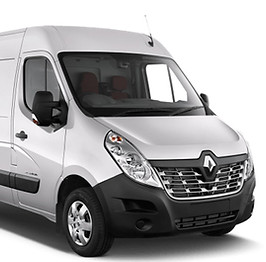
LEAF SPRING
RENAULT MASTER
Leaf springs for Renault Master from 110 EUR • Popular articles always in stock, ready to ship.

RENAULT MASTER
2010 ➞


RENAULT MASTER
1994 - 2010


ONLINE INQUIRY
If you are not sure which of the many Renault Master leaf springs fits your vehicle, please submit your inquiry online and we will email you a quotation. If you find our quotation suitable, your product is just a click away.


Renault Master leaf spring: essential service information and technical data
Renault's Master van has anchored the French manufacturer's commercial vehicle lineup since 1980, evolving through multiple generations while maintaining market leadership across European fleets. The current third-generation model shares its engineering platform with Opel Movano and Nissan NV400, leveraging alliance resources to deliver competitive commercial vehicle technology. Rear leaf spring suspension provides the load-bearing foundation for Master's 1,000-2,200 kg payload range across panel van, chassis cab, and minibus configurations. Understanding leaf spring service requirements becomes paramount for Master operators, as suspension condition governs not only load capacity and ride quality but also fundamental vehicle safety parameters including axle control, steering predictability, and emergency handling response across the demanding commercial vehicle duty cycles these vans experience daily.
Leaf spring roles in Renault Master axle positioning and load support
Examining your Master's rear suspension reveals leaf springs fulfilling dual responsibilities that prove equally essential for safe operation. Structurally, leaf spring assemblies create the exclusive mechanical connection between rear axle and chassis rails—removing or weakening these leaf springs eliminates all axle positioning capability, as no supplementary linkage exists to maintain axle location. This connection must withstand continuous operational forces: forward thrust during acceleration, rearward loading during braking, sideways stress during cornering, and vertical impacts from pavement irregularities. Functionally, leaf springs must absorb energy from road inputs while supporting static payload weight and dynamic loading shifts. Leaf spring fracture, particularly affecting main leaves in the critical zone forward of axle mounting points, compromises axle positioning control, potentially allowing lateral or longitudinal axle movement that transforms predictable handling into dangerous instability. Maintaining identical leaf spring dimensions on both vehicle sides proves essential—even minor arc height, length, or thickness differences between left and right leaf springs create non-parallel axle geometry producing uneven tire wear, steering pull, and unpredictable handling characteristics. Your Master's suspension system integrates these foundational leaf springs with shock absorbers controlling bounce and rebound velocities, bump stops preventing extreme compression damage, and stabilizer bars (on applicable configurations) limiting body roll, yet leaf spring integrity remains the fundamental prerequisite enabling safe Renault Master operation.
Metallurgical specifications governing Renault Master leaf spring production
Two steel alloy families dominate European commercial vehicle leaf spring manufacturing, with Renault Master applications specifying both depending on design approach and load requirements. Parabolic single-leaf configurations typically mandate 51CrV4 alloy—a composition containing 0.51% carbon providing baseline hardness, 1.1% chromium enhancing wear resistance, and 0.2% vanadium improving fatigue strength. This premium alloy justifies elevated material costs through superior durability when entire suspension capacity concentrates in single leaf spring components. Multi-leaf pack designs more commonly specify 55Cr3 steel containing 0.51% carbon, 0.7% chromium, and 0.7% manganese, delivering acceptable performance at reduced expense when multiple leaves distribute operational stresses across leaf spring assemblies. Raw material selection represents merely the foundation; subsequent thermal processing determines whether leaf springs exhibit proper operational characteristics or fail prematurely in Renault Master service. Manufacturing protocols demand heating leaf spring blanks to 850-950°C enabling molecular restructuring, rapid quenching in temperature-controlled oil baths at 45-55°C locking desired properties, tempering at 400-500°C reducing brittleness while maintaining strength, then gradual cooling completing the metallurgical transformation. Even slight deviations—incorrect temperature profiles, improper timing sequences, inadequate cooling rates—produce leaf springs exhibiting either catastrophic brittleness causing sudden fracture or insufficient hardness permitting permanent deformation under operational loading in your Renault Master suspension.
Multiple pathways leading to Master leaf spring failure
Renault Master leaf spring failures stem from numerous independent mechanisms, each producing fractured components requiring different diagnostic approaches despite superficial similarities. Surface damage from road hazards—stone impacts, pothole strikes, construction site debris contact—creates crack initiation sites propagating slowly through subsequent months until sudden fracture occurs. Steel manufacturing maintains exceptional purity standards, yet microscopic non-metallic inclusions inevitably remain embedded throughout material; these particles create internal stress concentrations where cracks eventually initiate as leaf springs accumulate millions of load cycles. Heat treatment errors during leaf spring production—quenching temperature deviations, insufficient tempering duration, rushed cooling phases—generate components lacking designed material properties from initial installation. Repair attempts involving open-flame heating burn surface carbon from leaf springs, creating weakened outer layers where maximum stress concentration occurs during flexing. Corrosive environments accelerate leaf spring degradation as road chemicals and moisture penetrate grain boundaries, progressively weakening material until operational loads exceed remaining capacity. Installation errors where U-bolt fasteners receive inadequate torque—specifications typically requiring 130-200 Nm depending on thread diameter—permit leaf spring shifting within mounts, creating friction wear gradually enlarging center holes until material fractures. Continuous operation above rated payload systematically consumes available fatigue life; each overloaded trip advances leaf springs toward eventual failure regardless of other factors. Severe service conditions—rough access roads at industrial sites, frequent maximum-payload operation, aggressive stop-start urban delivery cycles—subject Master leaf springs to duty exceeding original engineering assumptions. Occasionally, vehicle development priorities emphasizing cost reduction produce leaf spring specifications marginally adequate for nominal ratings but insufficient for real-world operational demands affecting your Renault Master.
Technical limitations preventing successful leaf spring welding repairs
Welding fractured Master leaf springs appears economically attractive initially but creates fundamentally unsound repairs with serious safety implications. The core challenge involves leaf spring steel's engineered metallurgical properties—the carefully balanced combination of hardness preventing permanent deformation and flexibility enabling repeated load cycles becomes irreversibly compromised by welding's intense localized heating. Zones surrounding weld beads undergo uncontrolled metallurgical transformations, developing mechanical properties dramatically different from properly heat-treated base material. These heat-affected regions typically exhibit increased brittleness while losing the carefully engineered flexibility essential for absorbing millions of load cycles. Stress concentrations at transitions between welded and unwelded material initiate new crack formation shortly after repaired leaf springs resume service. Welded Master leaf spring repairs rarely survive beyond several weeks before re-fracturing—sometimes at original weld locations, sometimes adjacent where compromised material properties cannot withstand operational stresses. Professional leaf spring manufacturing achieves uniform material properties throughout components via controlled steel chemistry, precision forming operations, and monitored thermal treatments. Field welding repairs lack these production controls, inevitably creating joints fundamentally weaker than surrounding material regardless of welder expertise. Beyond technical inadequacy, welded leaf spring repairs introduce serious safety concerns: unexpected fracture during Renault Master operation can precipitate sudden axle displacement, potentially causing loss of directional control with minimal driver warning.
Evaluating safe operation limits with damaged Master leaf springs
Determining whether damaged Master leaf springs permit continued operation requires systematic assessment across six critical parameters. Primary consideration involves precise fracture location: main leaf breaks between axle and forward attachment points demand immediate replacement creating urgent safety concerns, while rear-section fractures present reduced risk permitting temporary operation under controlled conditions. Leaf spring design type significantly influences failure severity—parabolic single-leaf configurations concentrating complete suspension capacity where failure eliminates all support, versus multi-leaf assemblies where remaining intact leaves provide partial capacity after main leaf fracture. Within multi-leaf designs, identifying which specific leaf failed determines response urgency: main leaf damage requires immediate action, secondary leaf fractures allow limited operation, tertiary leaf damage permits extended use under reduced loading. Current vehicle loading profoundly affects risk levels: empty Master vans tolerate damaged leaf springs substantially better than vehicles approaching 3,500 kg gross weight limits. Stabilizer bar presence provides supplementary axle control partially compensating for leaf spring compromise on configurations including these components. Operational context influences acceptable risk thresholds: local delivery operations with frequent stops versus sustained motorway speeds present fundamentally different consequence profiles. Maximum hazard emerges when main leaf springs fracture forward of axles on Master vehicles lacking stabilizer bars while transporting substantial payloads—this scenario risks abrupt axle displacement potentially causing complete vehicle control loss. Conservative risk management dictates minimizing continued operation under high-risk conditions, proceeding only at substantially reduced speeds for direct transit to service facilities for immediate Renault Master leaf spring replacement.
Beyond leaf spring breakage: additional Master leaf spring deterioration patterns
Renault Master leaf springs develop various performance-compromising conditions without experiencing complete fracture. Progressive strength reduction manifests as gradually increasing rear sag under standard payload levels—this deterioration signals leaf springs approaching service life limits despite lacking visible cracks. Normal commercial vehicle duty systematically reduces leaf spring capacity throughout 5-10 year service intervals as accumulated flexing cycles consume available material fatigue resistance. Eventually, leaf springs cannot maintain designed arc heights, causing suspension to settle progressively lower than specifications. Certain Master applications involving permanently mounted equipment—refrigeration units, hydraulic tail lifts, extensive storage systems, auxiliary power generators—frequently exceed factory leaf spring ratings from initial service. These demanding applications can expose leaf spring inadequacy within initial service months rather than years. Manufacturing defects occasionally create leaf springs exhibiting premature softening from improper heat treatment execution, losing designed strength early despite appropriate loading patterns. Reputable leaf spring manufacturers typically honor warranty claims addressing these production failures. Suspension noise complaints—squeaking, creaking sounds during articulation—usually indicate worn interlayer pads in multi-leaf assemblies or degraded bushings at leaf spring mounting points; while these noises rarely indicate imminent fracture, they suggest accelerated wear deserving professional inspection. Factory leaf spring specifications optimized for maximum payload inevitably compromise unladen comfort, producing harsh ride characteristics when Master vehicles operate empty or lightly loaded—this represents unavoidable engineering trade-offs in commercial vehicle suspension design affecting your Renault Master ride quality.
Identification procedures for correct Master leaf spring specifications
Initiate Master leaf spring identification by locating OEM article numbers on existing components—manufacturers stamp these numbers into leaf spring surfaces, paint them on visible areas, or display them on adhesive labels. Article number entry in our online catalog provides definitive fitment verification eliminating specification ambiguity. When article numbers prove illegible through corrosion, paint loss, or damage, submit production year and VIN through our inquiry system enabling manufacturer database consultation. Many straightforward Master leaf spring orders require only production year and leaf count data, though complex configurations occasionally necessitate additional verification information. Physical measurements—total length, material thickness, width dimensions, center hole diameter, arc radius—enable approximate specification matching, though measurements alone cannot guarantee absolute fitment certainty given manufacturing tolerances across Master model years. Photograph submission assists identifying non-standard leaf spring installations on used Master vehicles where previous modification records remain unavailable. Multi-leaf assemblies permit economical repairs through individual leaf purchases when only single components within packs need replacement. Paired leaf spring purchases aren't mandatory—approximately 70% of our customers successfully order individual leaf springs—though specific circumstances favor paired replacement: aged Master vehicles where non-fractured leaf springs show weakness, extended operation after initial failure creating elevated stress in opposite assemblies, or fleet maintenance policies prioritizing vehicle availability over immediate component costs in your Renault Master servicing protocols.
Self-service replacement procedures for Master leaf springs
Mechanically skilled Master operators possessing appropriate equipment can successfully accomplish leaf spring replacement. Essential equipment includes commercial-grade lifting apparatus (hydraulic jacks and safety stands rated for vehicle weight), precision torque wrenches, comprehensive socket collections including deep-reach designs for U-bolt access, penetrating oils for corroded fasteners, and proper personal protective equipment. Elevate Master vehicles on stable, level surfaces and fully unload rear suspensions before removing leaf spring mounting hardware. Torque specifications vary by U-bolt thread size: M12 fasteners require 130 Nm, M14 need 200 Nm, M16 demand 315 Nm application. Reduce these values 10-15% when using anti-seize compounds or encountering pre-lubricated threads. Retorquing after 1,000-5,000 km proves essential as replacement leaf springs settle and components properly seat. Video tutorials demonstrating Master-specific leaf spring replacement procedures appear in our technical blog. Despite straightforward procedures, many Master operators choose professional installation—corroded fasteners typical on aged commercial vehicles, restricted underbody access on certain configurations, and operational efficiency considerations often justify professional service over DIY time investment for your Renault Master maintenance.
Why choose our Renault Master leaf springs
Direct-from-manufacturer ordering bypasses wholesale distribution channels, providing Renault Master operators outstanding value without quality sacrifice. Our leaf spring manufacturing replicates original specifications exhaustively—precise dimensional matching, identical spring rate behavior, equivalent service longevity, matching protective surface treatments ensure seamless replacement integration. Individual leaf components available for multi-leaf assemblies enable cost-effective repairs replacing only damaged elements rather than complete assemblies.
Protection exceeds conventional standards through comprehensive warranty structure: the legally mandated 2-year EU guarantee supplemented by our exclusive 2-year manufacturing extension, delivering exceptional 4-year total coverage demonstrating absolute production confidence. Stock depth spans both common Renault Master specifications and rarely-requested configurations, with complete suspension support through immediate availability of complementary components—leaf spring bushings, U-bolt hardware, bracket assemblies.
Our purpose-designed online commerce system delivers capabilities traditional automotive suppliers cannot match—complete specification transparency, streamlined selection processes, extensive technical documentation. Product range extends beyond standard replacement leaf springs to include reinforcing systems and auxiliary enhancements, backed by application-focused technical guidance addressing your specific Master loading scenarios. Protected shipping—robust packaging for components under 80kg, secure pallet mounting for heavier leaf spring assemblies—guarantees damage-free European delivery from strategically positioned warehouses minimizing shipping durations.
Fleet operations, independent workshops, and professional service centers access commitment-based pricing structures recognizing volume requirements. Technical proficiency derives from focused specialization—exceeding 25 years dedicated exclusively to leaf spring engineering positions us as genuine specialists in commercial vehicle suspension technology serving your Renault Master needs.