


LEAF SPRING
MITSUBISHI L200
Leaf springs for Mitsubishi L200 from 125 EUR • Popular articles always in stock, ready to ship.

MITSUBISHI L200
2015 ➞


AIR SPRING SYSTEM

MITSUBISHI L200
2005 - 2015


LEAF SPRING | 4+2 LEAF


MITSUBISHI L200
1996 - 2007


ONLINE INQUIRY
If you are not sure which of the many Mitsubishi L200 leaf springs fits your vehicle, please submit your inquiry online and we will email you a quotation. If you find our quotation suitable, your product is just a click away.


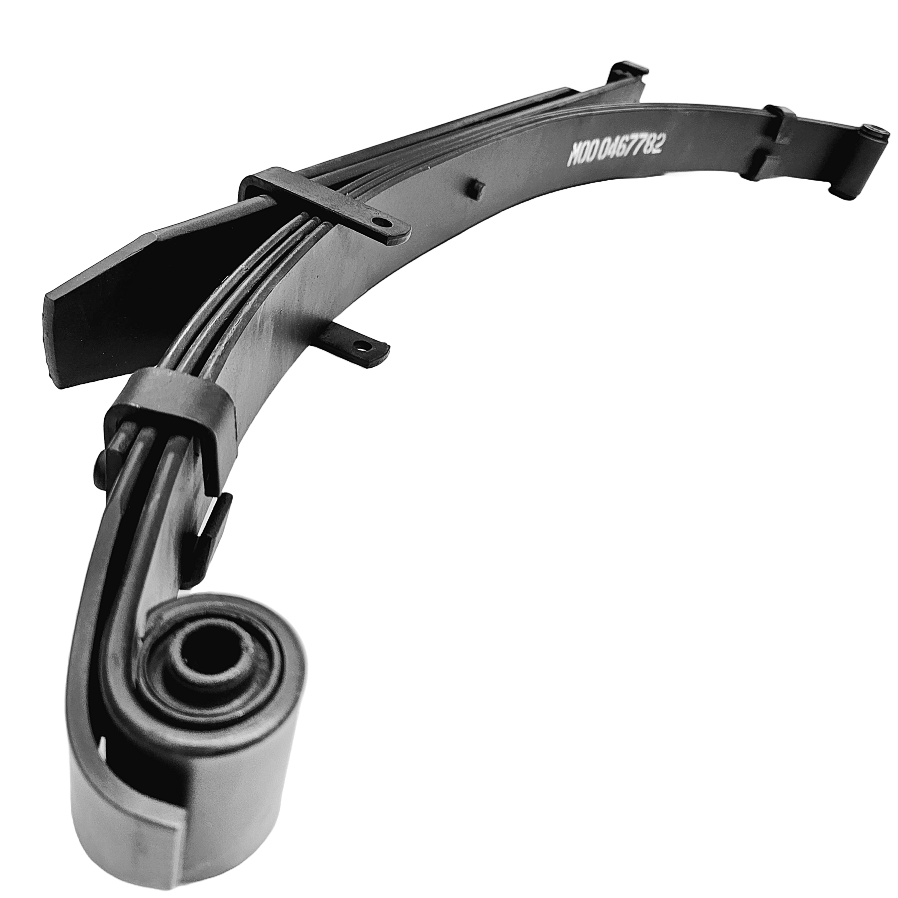


Mitsubishi L200 leaf spring: technical guide and service information
Mitsubishi's L200 pickup has maintained continuous production since 1978, establishing exceptional reputation for durability and off-road capability across global markets. The current fifth-generation model, introduced in 2015, delivers refined on-road behavior while preserving rugged working truck characteristics that appeal equally to commercial operators and lifestyle buyers. Available throughout European markets via Mitsubishi's commercial vehicle network, the L200 offers 1,000-1,200 kg payload capacity across Single Cab, Club Cab, and Double Cab configurations favored by construction contractors, agricultural operations, and outdoor recreation enthusiasts. Rear leaf spring suspension provides the mechanical foundation enabling L200's dual-purpose versatility—capable of demanding work-site duty while maintaining acceptable comfort for daily transportation and recreational towing. For L200 owners utilizing these versatile pickups across construction applications, farming operations, adventure activities, or tradesperson transport, leaf spring condition governs payload capability, towing stability, chassis durability, and handling characteristics throughout the diverse duty cycles these purpose-built trucks regularly encounter.
Leaf spring functions supporting L200 axle positioning and load capacity
Mitsubishi L200 rear suspension architecture assigns leaf springs two fundamentally distinct yet interconnected responsibilities. Structurally, leaf spring assemblies create the exclusive mechanical linkage between rear axle housing and chassis frame rails—Mitsubishi's design approach employs no supplementary control arms, trailing links, or positioning mechanisms. This design simplicity reduces component complexity but creates absolute dependence on leaf spring integrity for maintaining proper axle location and alignment. Load-bearing responsibilities demand leaf springs support static payload weight in the cargo bed while managing dynamic forces from acceleration, braking, maneuvering across uneven terrain, and absorbing shock loads from off-road obstacles typical of L200 usage patterns. When main leaf spring components fracture—particularly in high-stress zones between axle U-bolt clamps and forward spring shackles—axle positioning becomes compromised, potentially permitting movement that manifests as handling unpredictability or severe directional instability. Dimensional consistency between left and right leaf spring assemblies proves critical: mismatched arc heights, length discrepancies, or thickness variations create non-parallel axle geometry producing uneven tire loading, accelerated wear progression, and persistent steering anomalies demanding constant correction. Your L200 suspension system integrates these foundational leaf springs with shock absorbers controlling oscillation frequencies, progressive bump stops preventing extreme compression, and stabilizer bars limiting body roll during cornering, yet fundamental leaf spring soundness determines whether your Mitsubishi L200 maintains predictable, controlled behavior across the demanding operational spectrum these versatile pickups experience.
Steel specifications and thermal processing in L200 leaf spring manufacture
Mitsubishi L200 leaf spring production utilizes European steel alloy standards engineered for pickup truck applications combining high payload capacity with repeated shock absorption demands. Most L200 specifications employ either 51CrV4 or 55Cr3 steel depending on leaf spring design philosophy and target load ratings. The 51CrV4 composition—containing 0.51% carbon establishing baseline strength, 1.1% chromium providing wear resistance, 0.2% vanadium enhancing fatigue properties—delivers exceptional durability justifying premium material investment for parabolic single-leaf designs or main leaves in multi-leaf assemblies where maximum reliability proves essential. Alternative 55Cr3 steel containing 0.51% carbon, 0.7% chromium, and 0.7% manganese offers adequate performance at reduced material cost for secondary leaves or applications where multiple components distribute operational stresses across leaf spring packs. Raw material selection establishes foundational capabilities, but subsequent thermal processing determines whether finished leaf springs exhibit proper operational characteristics or fail prematurely in Mitsubishi L200 service. Manufacturing protocols demand heating formed leaf spring blanks to 850-950°C facilitating molecular restructuring, rapid immersion in temperature-controlled oil baths at 45-55°C locking desired material properties, tempering at 400-500°C optimizing the critical hardness-flexibility balance, then gradual cooling completing the metallurgical transformation cycle. Temperature deviations, timing errors, or process control failures during any manufacturing phase produce leaf springs exhibiting either dangerous brittleness causing unexpected fracture or inadequate hardness permitting permanent deformation under L200 pickup truck loading conditions.
Understanding L200 leaf spring failure patterns and welding repair limitations
Mitsubishi L200 leaf spring failures emerge from multiple independent mechanisms, though determining precise root causes often requires specialized metallurgical analysis. Off-road impact damage from rocks, ruts, obstacles, and aggressive terrain creates surface defects becoming crack initiation sites propagating slowly until catastrophic fracture months after initial damage events. Steel production inevitably incorporates microscopic non-metallic inclusions throughout material; these particles remain benign under normal conditions but create internal stress concentrations where fatigue cracks eventually develop as leaf springs accumulate millions of flexing cycles through varied terrain and loading scenarios. Heat treatment errors during leaf spring manufacturing—quenching temperature deviations, insufficient tempering periods, accelerated cooling phases—generate components lacking designed material properties from initial installation. Corrosive environments accelerate deterioration: road salt, agricultural chemicals, moisture exposure penetrate steel microstructure along grain boundaries, progressively weakening material until operational loads exceed remaining capacity. Installation errors where U-bolt fasteners receive inadequate torque—pickup applications typically requiring 200-315 Nm depending on fastener dimensions—permit leaf spring movement within mounting clamps, creating friction wear gradually enlarging center holes until fracture occurs. Continuous operation exceeding rated payload systematically consumes available fatigue life; each overloaded trip advances leaf springs toward eventual failure. Severe service conditions characteristic of L200 usage—construction site access, farm tracks, off-road recreation, frequent maximum-payload operation—subject leaf springs to duty substantially exceeding original engineering assumptions. Attempted welding repairs introduce additional failure pathways: the intense localized heating necessary for fusion welding fundamentally transforms steel microstructure in zones surrounding weld deposits, creating heat-affected regions with dramatically compromised mechanical properties. These zones typically become excessively brittle while losing engineered flexibility essential for repeated load cycles. Welded L200 leaf spring repairs rarely survive beyond several weeks before re-fracturing, as the compromised material cannot withstand normal operational stresses from payload, towing, or rough terrain typical in your Mitsubishi L200 applications.
L200 leaf spring deterioration beyond breakage
Mitsubishi L200 leaf springs develop numerous performance-compromising conditions without experiencing complete fracture. Progressive strength reduction manifests as gradually increasing rear suspension sag under typical payloads—this deterioration signals leaf springs approaching service life limits despite lacking visible cracks or breaks. Standard pickup truck duty systematically reduces leaf spring load capacity throughout 5-10 year service intervals as accumulated flexing cycles consume available material fatigue resistance. Eventually, leaf springs cannot maintain designed arc configurations, causing suspension to settle progressively lower than specifications, affecting ground clearance and cargo bed geometry. Specific L200 applications involving permanently mounted equipment—canopy installations, auxiliary fuel systems, agricultural spray equipment, tool storage systems—frequently exceed factory leaf spring capacity ratings from initial service. These demanding uses can expose leaf spring inadequacy within initial service months rather than years of operation. Manufacturing defects occasionally create leaf springs exhibiting premature softening from improper heat treatment execution, losing designed strength early despite appropriate loading patterns. Reputable leaf spring manufacturers typically honor warranty claims addressing these production failures. Audible suspension complaints—squeaking, creaking noises during articulation—usually indicate worn interlayer pads in multi-leaf assemblies or degraded bushings at leaf spring mounting locations; while these noises rarely signal imminent fracture, they suggest accelerated wear patterns deserving professional inspection. Factory leaf spring specifications optimized for maximum payload ratings inevitably compromise unladen ride comfort, producing harsh characteristics when L200 vehicles operate empty—this represents unavoidable engineering trade-offs in dual-purpose pickup suspension design affecting your Mitsubishi L200 ride quality during unloaded daily commuting between work sites and home.
Suspension capacity enhancements for Mitsubishi L200 applications
Leaf spring reinforcing kits increase Mitsubishi L200 payload and towing capacity through installing supplementary leaves beneath existing assemblies—particularly valuable for trucks consistently operating near original weight ratings or towing heavy trailers and campers. Complete reinforcing systems include extended U-bolts accommodating thicker leaf spring packs, longer center bolts, and mounting hardware; proper installation demands careful attention to leaf spring alignment and precise fastener torque specifications meeting pickup truck requirements. Progressive overload springs provide alternative enhancement through additional leaf spring components engaging exclusively under substantial loading. These helper leaf springs remain inactive during unloaded operation preserving ride comfort, activating to provide supplementary support when L200 trucks carry significant bed loads or tow recreational vehicles. Air suspension systems offer premium capability through continuously adjustable support using integrated compressors with cab-mounted controls, particularly popular among L200 owners prioritizing both working capability and recreational towing comfort. Some L200 operators install upgraded primary leaf springs with higher capacity ratings, replacing factory components with reinforced designs better suited to demanding duty cycles. Suspension lift kits incorporating modified leaf springs enable larger tire fitment and increased ground clearance for serious off-road applications, though these modifications affect vehicle geometry and on-road handling characteristics. All suspension enhancement components we supply satisfy applicable regulatory standards where relevant, though L200 owners should verify compliance for their specific modification type and operating jurisdiction.
Identifying appropriate leaf spring specifications for your L200
Mitsubishi L200 leaf spring identification commences by examining existing components for OEM part numbers—manufacturers stamp these numbers into leaf spring surfaces, paint them on visible sections, or display them on metallic identification tags. Part number entry in our online catalog provides definitive fitment confirmation eliminating specification uncertainty. When part numbers prove illegible through corrosion, paint deterioration, or off-road damage typical of L200 usage, submit production year, VIN, and cab configuration details through our inquiry system enabling manufacturer database consultation. Many straightforward L200 leaf spring orders require only production year, generation (fifth-generation from 2015 onward being most common), cab type, and leaf count data, though complex configurations occasionally necessitate additional verification including engine type and market specifications. Physical dimension measurements—overall length, material thickness, width dimensions, center hole diameter, arc radius—enable approximate specification matching, though measurements alone cannot guarantee absolute fitment certainty given manufacturing tolerances across L200 variants and market-specific differences between European, Australian, and Asian specifications. Photograph submission assists identifying non-standard leaf spring installations on used L200 trucks where previous modification history remains unknown—aftermarket lift kits, reinforcing systems, or custom fabrication often complicate identification. Multi-leaf assemblies permit economical repairs through individual leaf purchases when only single components within packs require replacement. Paired leaf spring purchases aren't mandatory—approximately 70% of our customers successfully order individual leaf springs—though specific circumstances favor paired replacement: aged L200 trucks where both leaf springs demonstrate weakness, extended operation after initial failure creating elevated stress in opposite assemblies, or situations where matching left-right characteristics proves critical for towing stability and off-road handling in your Mitsubishi L200 operations.
Why choose our Mitsubishi L200 leaf springs
Direct manufacturer sourcing eliminates wholesale distribution margins, providing Mitsubishi L200 owners exceptional value alongside OEM-specification quality assurance. Our leaf spring manufacturing replicates original equipment standards comprehensively—precise dimensional accuracy, identical spring rate characteristics, equivalent service longevity, matching protective surface treatments ensure seamless replacement integration. Individual leaf components available for multi-leaf assemblies enable cost-effective repairs replacing only damaged elements rather than complete assemblies.
Warranty coverage surpasses industry standards through comprehensive dual-layer protection: the legally mandated 2-year EU statutory guarantee enhanced by our exclusive 2-year manufacturing extension, producing unmatched 4-year total coverage reflecting absolute production quality confidence. Stock availability encompasses both common Mitsubishi L200 specifications and infrequently-requested configurations including older generation models and regional variants, with complete suspension support through immediate availability of complementary components—leaf spring bushings, heavy-duty U-bolt hardware, shackle assemblies.
Our specialized online platform delivers ordering capabilities conventional pickup truck parts suppliers cannot replicate—complete specification transparency, streamlined selection workflows, extensive technical documentation availability. Product range extends beyond standard replacement leaf springs to encompass reinforcing systems, overload springs, and capacity upgrades, backed by application-specific technical consultation addressing your particular Mitsubishi L200 usage scenarios including towing, off-road recreation, and heavy payload requirements. Protected shipping protocols—reinforced packaging for lighter components, secure pallet configurations for heavy leaf spring assemblies—guarantee damage-free European delivery from strategically positioned distribution centers minimizing transit intervals.
Commercial fleet operators, recreational vehicle owners, independent workshops, and professional service facilities access volume-based pricing structures acknowledging purchasing commitment levels. Technical proficiency originates from concentrated specialization—exceeding 25 years devoted exclusively to leaf spring engineering establishes us as genuine specialists in commercial vehicle and pickup truck suspension technology serving your Mitsubishi L200 requirements.